Motor Yacht vs Sailing Yacht Electrical Needs: A Comparison Guide
A motor yacht draws its energy from generators and large alternators, while a sailing yacht counts every amp-hour. That difference shapes the whole design, from battery bank to cable size.
At first glance, the electrical needs of a motor yacht and a sailing yacht look similar: both have a battery bank, a shore power connection, lighting and navigation electronics. But where the energy comes from and where it goes are fundamentally different. That difference shapes the whole design, from system voltage and battery type to cable sizes and maintenance priorities.
The key difference: where does the energy come from?
On a motor yacht the main engines run continuously under way and large alternators refill the battery bank quickly. At anchor and under way, AC demand is mostly covered by the generator. Energy is plentiful but "expensive": you pay for it in fuel, noise and generator hours.
On a sailing yacht the main engine is off for most of the day. Energy comes from solar panels, a wind generator, a hydrogenerator and a small alternator during short engine runs. Every amp-hour is counted, and the battery bank is the backbone of days spent self-sufficient. We explain how to calculate consumption, with a worked table, in our guide to daily energy consumption on board.
Comparison table
| Topic | Motor yacht | Sailing yacht |
|---|---|---|
| Typical DC system voltage | 24 V common; larger yachts have 24 V house and separate start circuits | 12 V common; 24 V on larger sailing yachts |
| AC system | Generator, 230 V single-phase or 400 V three-phase | Usually inverter and shore power |
| Shore power | 32 A–63 A depending on size, three-phase on large yachts | Mostly 16 A single-phase |
| Main energy source | Generator and main engine alternators | Solar, wind, hydrogenerator, alternator |
| Large consumers | Air conditioning, galley, stabiliser, hydraulics, thrusters | Fridge, autopilot, windlass, watermaker, navigation instruments |
| Battery bank | Accepts high charge current, carries AC loads for short periods | Tolerates deep discharge, high usable capacity |
| Wiring challenges | Large cross-sections, hot engine room, long runs | Mast wiring, deck glands, moisture |
| Safety priorities | AC safety, generator changeover, galvanic protection | Navigation lights, antenna, securing batteries against heel |
The values in the table show typical cases; every boat should be assessed against its own equipment list.
Same device, two different stories
A simple example makes the difference clear. A compressor fridge drawing an average of 4 A on a 12 V system uses roughly 40–50 Ah a day. On a motor yacht that equals a short spell of output from the generator or the main engine alternators and barely registers in the energy budget. On a sailing yacht spending three days at anchor, the same fridge is the largest single item and can account for nearly a third of the daily budget on its own. That is why fridge insulation, compressor efficiency and condenser ventilation are an energy issue on a sailing yacht. On a motor yacht the priority is deciding which source feeds kilowatt-level loads such as air conditioning or the water heater, and in what order. The same logic applies to lighting: LED conversion makes a difference mainly in comfort and heat on a motor yacht, but directly in autonomy on a sailing yacht.
Key topics on motor yachts
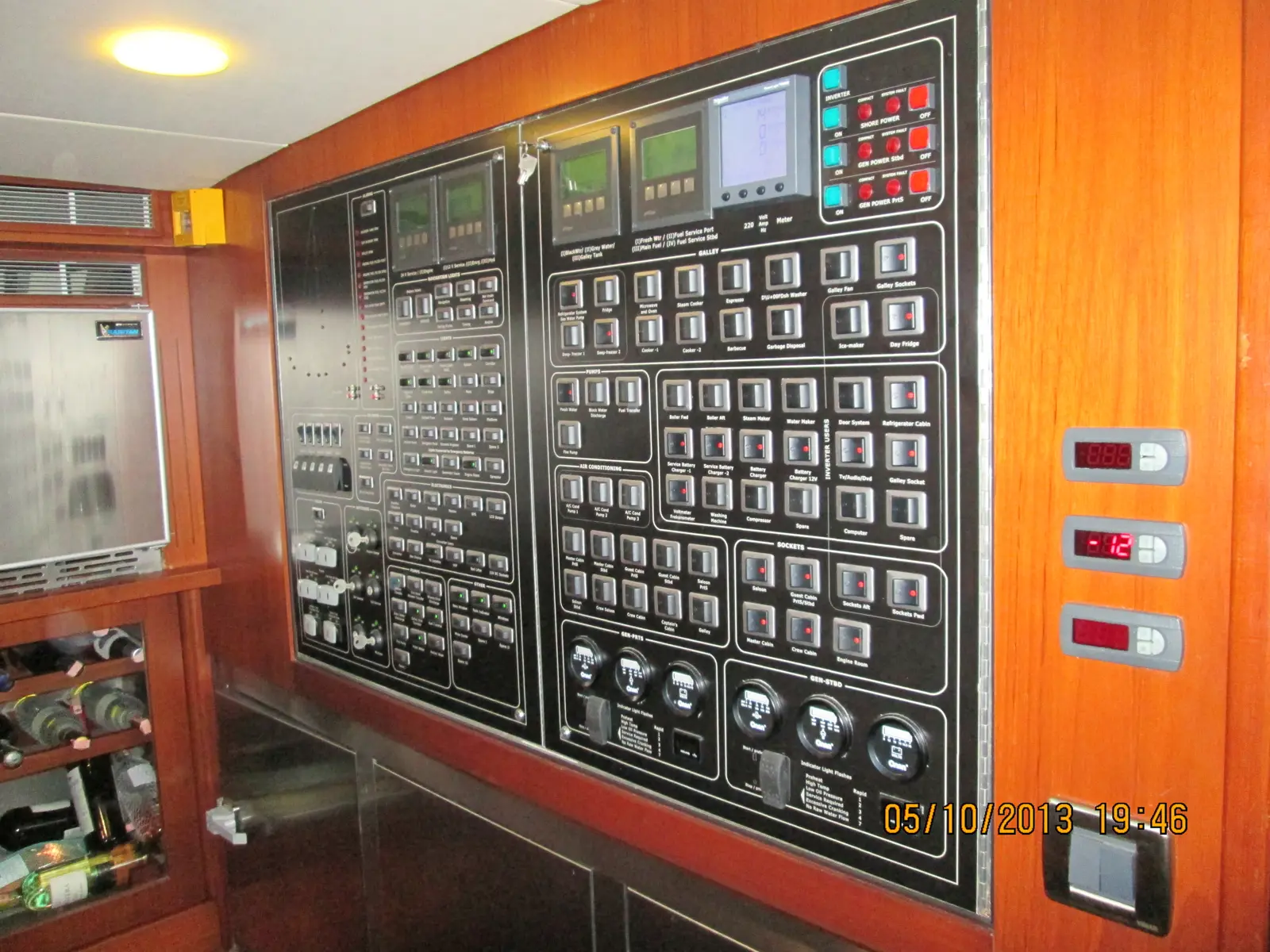
Motor yacht design revolves around distributing high AC power safely. Changeover between shore power, generator and inverter must be interlocked so that two sources are never connected to the same busbar at the same time. On large yachts, three-phase shore connections, phase balance and isolation transformers also need attention; we cover this in our article on shore power connections in the marina.
The most requested topic in recent years is the "silent anchorage": switching the generator off at night and running the fridge, lighting and limited air conditioning from a lithium bank. That requires a large inverter/charger, fast charging from the main engine alternators and a properly sized bank. Gyro stabilisers such as Seakeeper also add a significant item to the energy budget; depending on the model they are AC- or DC-powered, and if they will run at anchor, the energy source must be planned from the start.
Heat is decisive in motor yacht electrics too. Engine room temperature reduces the current-carrying capacity of cables, and this correction factor must not be ignored when choosing cross-sections.
Key topics on sailing yachts
On a sailing yacht the first question is "how much can I generate?". Solar panels on a bimini or arch, with MPPT charge controllers, can cover most of the daily consumption in the Aegean summer. You will find installation details in our guide to solar panels and MPPT on sailing yachts. When the engine runs and the standard alternator falls short, an external regulator or DC-DC charging can raise efficiency; see our article on alternators and external regulators.
Other issues specific to sailing yachts:
- Mast wiring: cables for the masthead light, deck light, wind sensor and VHF antenna pass through deck glands and connections at the mast foot. Moisture and corrosion make these points the most frequent source of faults.
- Heel angle: batteries must be secured in every direction; flooded batteries can spill electrolyte when heeled.
- Weight and volume: the low weight and high usable capacity of lithium batteries translate into a performance advantage on a sailing yacht.
- Autopilot: one of the most constant consumers on long passages; voltage drop on its supply affects course-keeping.
Catamarans and gulets
Sailing catamarans resemble monohull sailing yachts in their energy budget, but their large roof area allows more solar panels. Long cable runs between the hulls make voltage drop calculations important. On gulets, generator, air conditioning and galley loads usually bring the electrical infrastructure closer to that of a motor yacht.
Common ground
Whatever the boat type, some rules never change. Cables are fused close to the source, tinned marine cable is used, and DC negative and AC grounding are designed correctly. ISO 13297 sets the basic requirements for AC and DC installations on small craft, and ABYC standards are a widely used reference in the field. Galvanic corrosion, stray current and battery monitoring matter on both types as much as energy generation does.
Planning steps
- List your consumers: write down each device's power, voltage and daily hours of use.
- Identify your energy sources: calculate how much the generator, alternator, solar, wind and shore power will really contribute.
- Choose the system voltage: consider 24 V if there are many high-current loads.
- Size the battery bank: calculate usable capacity for the autonomy you want.
- Design distribution and protection: plan fuses, busbars, main switches and AC source changeover to the standards.
- Add monitoring: measure real consumption with a shunt-based battery monitor and verify the plan against the data. Here the Victron Energy ecosystem is one we use often on both motor and sailing yachts.
For details specific to your boat type, see our motor yacht electrical and sailing yacht electrical pages.
Plan it right with Aslan Yacht
With our team based in Turgutreis, we measure, plan and renew the energy systems of both motor yachts and sailing yachts in marinas around the Bodrum peninsula. For an energy infrastructure that suits your boat type and the way you use it, take a look at our energy and battery systems service and get in touch to discuss your project.
Frequently asked questions
Should a sailing yacht use 12 V or 24 V?
On small and mid-size sailing yachts, 12 V is still the most common system and equipment is easiest to find. As high-current loads such as a windlass, bow thruster or large inverter increase, 24 V noticeably reduces cable sizes and losses.
Can a motor yacht run air conditioning at night without the generator?
For a limited time, yes, with a large enough lithium bank and inverter, but air conditioning draws a lot of power. How many hours it can run must be worked out from the unit's power, the bank capacity and the charging available the next day.
Which is a catamaran's electrical profile closer to?
Sailing catamarans resemble monohull sailing yachts in their energy budget, but their large roof area can carry more solar panels. Power catamarans, with their AC loads and generator use, are closer to motor yachts.